


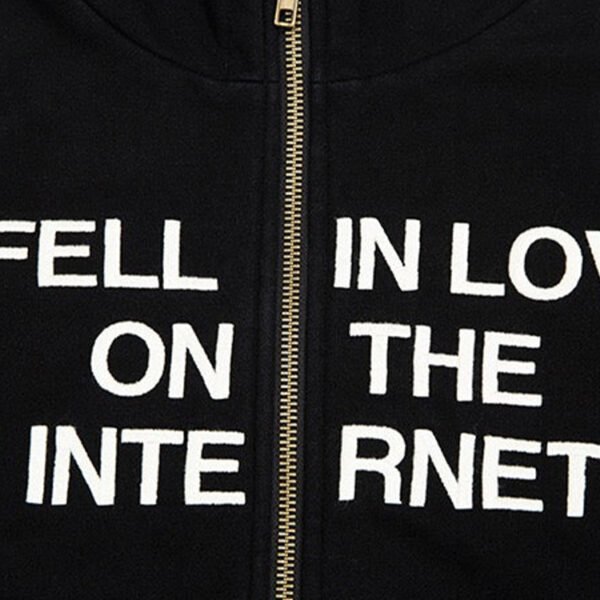



This printed zip jacket is built around zipper length versus front-body balance. The irregular white surface pattern, ribbed hem, and cuff framing make the front closure a visible proportion line, requiring coordinated approval of hardware position, body length, rib depth, and print scale.
Why Zipper Length Controls Front Balance
A zipper is more than a closure on this jacket; it establishes a vertical line that divides the front body. If it ends too high, the torso can look shortened; if it runs too low, the rib hem loses definition and the silhouette becomes visually heavy.
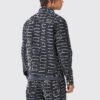
The supplied back image shows a relaxed jacket framed by ribbing at the hem and cuffs. Those boundaries create fixed visual anchors, so zipper endpoint, body length, and rib depth should be developed together rather than approved as separate measurements.
Reading the Surface Pattern as Evidence
The photographed jacket carries irregular white linear marks over a black base, with the texture continuing across the back and sleeves. This high-contrast treatment makes seam alignment, zipper interruption, and panel proportion easier to notice than on a plain shell.
Because the pattern is visually active, front-body balance must account for where the print crosses the closure and pocket areas. Buyers should decide whether the marks remain continuous, are intentionally interrupted, or require panel-specific placement during development.
Rib Framing and Hem Relationship
The lower hem appears ribbed and creates a distinct band beneath the jacket body. Increasing that band can shorten the apparent torso, while reducing it may weaken the edge definition visible in the reference, especially when paired with a long central zipper.
Cuff ribbing provides a second proportional reference at the sleeve ends. A production sample should compare hem and cuff widths, ensuring the closure length, body length, and edge treatments read as a coordinated set when the jacket is worn.
Trade-Offs in Closure Proportion
A longer zipper can simplify dressing and strengthen a clean vertical line, but it may reduce the visual prominence of the rib hem. A shorter zipper preserves more lower-body structure, yet can create a crowded upper front if the collar and chest area are dense.
Hardware choice also affects perception: a bright metal finish can become a deliberate design feature against the printed ground, while a subdued finish reduces interruption. Exact zipper specification remains subject to development approval and source confirmation.
VeeWen Workflow Checkpoint
VeeWen should first lock a front balance sheet showing body length, rib height, collar reference, pocket zones, and the proposed zipper endpoint. This converts the visual argument into measurable checkpoints that patternmaking and sample review can share.
A finished prototype should then be reviewed from front, side, and back, with the print applied before judging closure proportion. Buyers approve the combined silhouette, hardware position, and pattern interruption strategy before the style advances toward MOQ: 100 pieces per style.
Approval Standard for Production Release
The approval sample should demonstrate that the zipper line supports the intended torso proportion without competing with the textured surface. Inspect the endpoint, tape alignment, rib attachment, cuff balance, and print continuity under normal viewing distance and close inspection.
Release the style only after the measurement sheet and artwork layout agree with the approved sample. If zipper length, rib dimensions, or print scale changes later, repeat the balance review because each adjustment alters the jacket's visual center.
Buyer Questions
Can the zipper be made shorter or longer?
Yes, zipper length can be developed with body length and rib height, but each change should be reviewed on a finished sample for front balance.
Is the white surface pattern included as standard?
The supplied image shows an irregular white-on-black pattern as visual evidence; artwork repeat, print technique, and final coverage require buyer confirmation.
What should buyers inspect on the first sample?
Inspect zipper endpoint, front alignment, rib attachment, body length, cuff proportion, and print interruption together, because these elements jointly determine the jacket's balance.
What is the minimum order for this jacket?
The commercial minimum is MOQ: 100 pieces per style. Hardware, print layout, colorway allocation, and size distribution should be finalized before production planning.
Approve the Closure Balance Sample
Share your preferred zipper finish, artwork direction, body measurements, and target size range with VeeWen. We will structure the review around front balance, rib framing, and MOQ: 100 pieces per style.


Reviews
There are no reviews yet.