


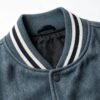
This custom washed varsity jacket is built around upper-body mobility. Its defined body, contrasting sleeves, ribbed openings, and broad chest embroidery create a structured appearance, but the armhole and underarm must allow reaching, layering, and sleeve rotation without pulling the front lettering out of alignment.
Why Armhole Geometry Matters in a Varsity Jacket
A varsity jacket must look compact while accommodating movement through the shoulders and upper arms. Armhole depth, curve shape, sleeve cap height, and sleeve rotation work together; changing one dimension can improve reach but create excess volume or disturb the cropped body.
The supplied image shows a defined shoulder line and sleeves extending cleanly from a contrasting body. That visual clarity makes mobility defects easy to see, especially when the wearer reaches forward and the front panel begins pulling across the embroidered chest.
Underarm Construction Manages Pull and Bulk
The underarm is the junction where body width, sleeve circumference, lining movement, and seam stress meet. A tight junction restricts reaching, while excessive ease can produce folds that interrupt the clean varsity outline and make the sleeve appear poorly rotated.
Development should evaluate the underarm in both a relaxed stance and active movement. VeeWen can adjust the curve, gusset requirement, seam allowance, and reinforcement plan according to the approved mobility target and the final shell and lining materials.
Sleeve Contrast Makes Rotation Visible
The black sleeves contrast strongly with the blue-grey body, so any diagonal twisting or drag line becomes visually prominent. Sleeve rotation should follow the natural arm position rather than forcing the cuff seam to align mechanically with the side seam.
A movement sample should include forward reach, crossed arms, and raised elbows. These actions reveal whether the sleeve cap, armhole, and underarm are sharing movement correctly, while the buyer can judge whether the jacket retains its intended cropped stance.
Embroidery Adds Localized Structure
The large light chest lettering is a source-visible feature that adds thread density and visual weight across the front. If the front panel pulls during movement, the embroidery can amplify the distortion by making waviness and spacing changes more noticeable.
Embroidery placement should therefore be approved after the body balance and armhole are stable. VeeWen's workflow should record the finished chest position from the center front and hem, then verify that placement across graded sizes and completed wash development.
Trade-Offs in Mobility and Silhouette
Deeper armholes and additional underarm ease can improve movement, but may reduce the compact appearance associated with a varsity jacket. A tighter armhole preserves structure yet can become uncomfortable over heavier layers or during forward reach.
The buyer should define the intended layering level before approving the block. The practical target is controlled ease: enough room for the expected garment combination, without allowing excess fabric to weaken the cropped body, rib hem, or sleeve profile.
VeeWen Workflow Approval Checkpoint
VeeWen should convert the reference into a mobility-focused technical package covering armhole measurements, sleeve rotation, underarm construction, reinforcement points, rib openings, embroidery coordinates, and wash observations. This connects the visual goal to repeatable development decisions.
Before production approval, the buyer should inspect the jacket on a moving wearer and review flat measurements after the selected wash process. Approval is complete only when movement, embroidery alignment, and silhouette remain acceptable together for MOQ: 100 pieces per style.
Buyer Questions
What is the main development risk for this jacket?
The main risk is restricted shoulder movement caused by an unsuitable armhole or underarm junction, which can also pull the embroidered front and disturb body balance.
Can the jacket support layered wear?
Yes, layering can be built into the block, but the buyer must define the intended base layers so armhole depth and underarm ease remain controlled.
When should embroidery placement be finalized?
Finalize embroidery after the armhole and body balance are approved, then verify chest coordinates through grading and the selected wash-development process.
What is the minimum order quantity?
VeeWen's exact commercial minimum is MOQ: 100 pieces per style, with final specifications and production documentation confirmed before order acceptance.
Approve Mobility Before Decoration
Share your layering intent, measurement targets, artwork, and wash direction with VeeWen. We will coordinate armhole mobility, underarm construction, embroidery placement, and varsity proportions for approval.



Reviews
There are no reviews yet.