


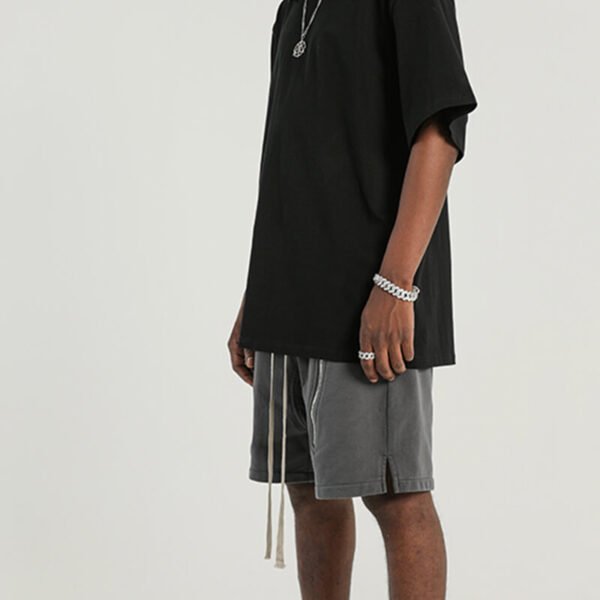
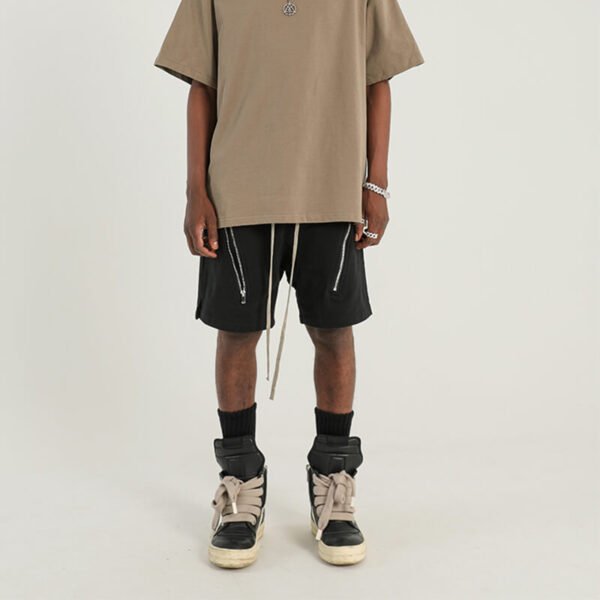

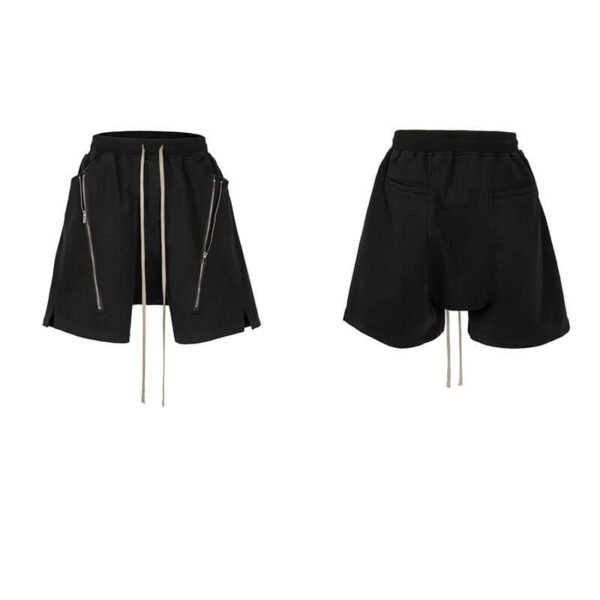


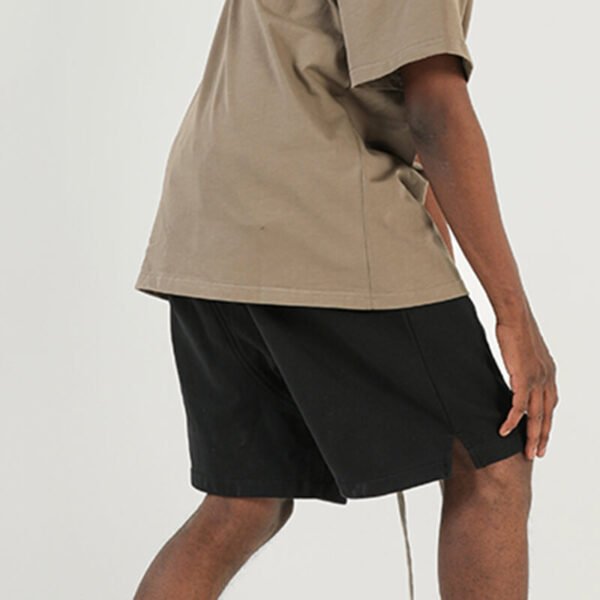





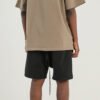


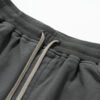

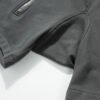
These custom utility shorts translate a rugged washed surface into a production-led durability question: how can raw-edge character remain visible while pocket openings, hems, and waistband exits stay controlled through wear? The answer depends on containment details, not surface appearance alone.
Containment Starts at the Pocket Opening
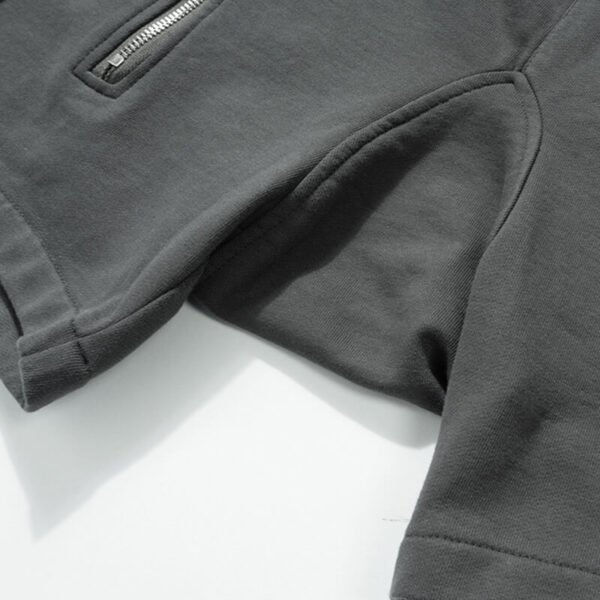
The angled front pockets are the strongest visible pressure points because their zipper tapes interrupt the body panel near the hip. A narrow opening limits exposed edge length, while consistent seam allowance and secure bartacks can help prevent spreading during repeated entry.
For development, the pocket bag, zipper tape, and surrounding topstitching should be reviewed as one assembly. A visually sharp angle is useful only when the opening remains flat, the tape does not twist, and the pocket mouth resists distortion during movement.
Raw Character Without Uncontrolled Fray
The washed charcoal appearance suggests a deliberately worn surface, but the image does not verify whether any edge is genuinely unfinished. VeeWen should separate visual rawness from structural exposure by selecting edge treatments that preserve character while containing yarn release.
At prototype review, inspect hems, pocket corners, waistband exits, and any internal seam exposed by movement. Compare untreated, overlocked, turned, and bound options against the approved aesthetic, then document the chosen method before grading or bulk cutting begins.
Waistband Exits Need Their Own Test
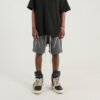
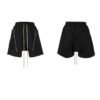
The long drawcords create a distinctive proportion and extend well below the shorts hem. That visible length increases snag and pull considerations, especially where the cord emerges from the waistband. Exit placement, eyelet security, and internal reinforcement therefore belong in the durability approval.
A buyer should decide whether the extended cords are essential to the range identity or merely styling evidence. If retained, confirm cord diameter, exit spacing, knot or stopper treatment, and laundering behavior so the feature remains intentional instead of becoming a loose-end risk.
Straight Fit Controls Stress Distribution
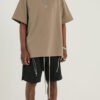
The loose straight silhouette gives the wearer room through the seat and thigh, reducing the concentrated strain associated with narrow shorts. However, added volume can shift stress toward pocket openings, crotch seams, and side seams when the wearer sits, bends, or carries contents.
VeeWen's pattern review should map those load zones before approving the final block. Measure the relationship between rise, thigh width, hem width, and pocket angle, because a balanced straight fit supports containment by distributing movement across more fabric.
Workflow Checkpoint: Build the Risk Map
Within VeeWen's product-development workflow, this style should enter sampling with a containment risk map rather than a generic trim list. Mark every raw-looking edge, zipper termination, cord exit, and high-contact seam, then connect each mark to a proposed construction response.
The first approval should compare appearance and handling together. Reviewers can pull the pocket mouths, flex the waistband, inspect hem stability, and assess cord security before grading. That evidence then guides the pattern, trim, and sewing instructions used for the MOQ: 100 pieces per style program.
Approval Criteria for a Durable Streetwear Short
The commercial decision is not whether the shorts look rugged in a still image; it is whether rugged styling survives the points where the garment is opened, pulled, washed, and repeatedly handled. Containment should be judged against the approved aesthetic at every exposed transition.
Approve the style when the pocket angles stay clean, the hems remain bounded, the cords remain secure, and the relaxed block does not create avoidable distortion. If any point fails, revise the construction package before committing the style to production quantities.
Buyer Questions
Can the raw-looking surface be reproduced consistently?
The image establishes visual direction, not a verified wash recipe. VeeWen should confirm fabric, garment treatment, edge method, and approval standards through physical sampling before production.
Are the zippers suitable for daily wear?
The image shows angled zipper placements but does not verify performance. Zipper gauge, tape, slider, stitching, and pull strength should be confirmed during sample evaluation.
Can the drawcord length be changed?
Yes, the visible length can be developed as a measured specification. Confirm cord diameter, exit spacing, reinforcement, and final hanging proportion against the approved sample.
What is the minimum order quantity?
The commercial minimum is MOQ: 100 pieces per style. Final materials, colors, trims, and construction details remain subject to the approved development record.
Approve the Containment Direction
Send the preferred fabric reference, wash target, zipper specification, and drawcord proportion to begin sampling. VeeWen can then convert the visual evidence into an approved containment package at MOQ: 100 pieces per style.



Reviews
There are no reviews yet.