

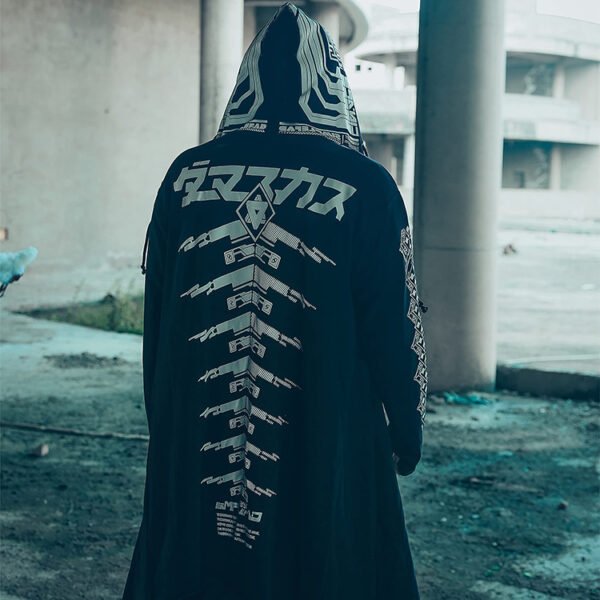


This custom long hooded jacket is developed around panel alignment, because its graphic language travels across hood, sleeve, and elongated body zones. The supplied image shows a dark outer layer carrying light geometric artwork near visible seams, making pattern registration a central approval issue rather than a decorative afterthought.
Why Panel Alignment Controls The Jacket
When artwork approaches a seam, even a small cutting or sewing displacement can interrupt its visual rhythm. On a long jacket, the effect becomes more noticeable because the eye follows graphics vertically from hood toward sleeve and body. Alignment therefore depends on pattern engineering, not printing alone.
The supplied image shows light graphic elements positioned against a black ground, with strong contrast that exposes registration errors. The development target is not a mathematically continuous image everywhere, but an intentional relationship at each approved seam, including matching direction, scale, and visible interruption.
Reading The Graphic Route
The hood carries prominent light artwork while the sleeve presents a separate but related vertical graphic path. This arrangement creates a directional frame around the wearer, so hood orientation and sleeve pitch influence how the composition is perceived when the garment is worn rather than displayed flat.
The long silhouette adds another alignment challenge: body panels extend the artwork's reading distance. Buyers should identify anchor points, such as hood center, shoulder seam, sleeve cap, pocket area, and hem region, then define which joins must match and which may intentionally break.
Pattern Engineering Before Printing
A reliable workflow begins by mapping the artwork onto the complete pattern set, including seam allowances and any panels that fold or overlap. The printer and pattern technician must share the same orientation references, because artwork positioned only on flat rectangles can shift after sewing.
Panel numbering, notches, grain direction, and registration marks should be included in the development package. These controls help the sewing team place printed pieces consistently, while the buyer can review a physical cut-and-sew sample to distinguish design intent from accidental misalignment.
Trade-Offs In Cross-Seam Graphics
Tighter alignment usually requires more preparation, narrower tolerance, and greater attention during cutting and assembly. That can reduce flexibility when panels are recut or artwork changes late. Looser placement improves production tolerance but may weaken the engineered graphic effect visible in the reference image.
The best decision is selective precision. Prioritize the hood center, shoulder transition, principal sleeve path, and any high-visibility body join, while allowing lower-impact areas to use practical tolerances. This approach protects the visual signature without treating every seam as equally critical.
VeeWen Development Workflow
VeeWen can convert the image into a placement-led tech pack by separating the jacket into hood, sleeve, front, back, and accessory panels, then marking artwork anchors and seam relationships. The development sequence should connect artwork mapping, pattern review, print strike-off, cut-panel inspection, sewing, and worn evaluation.
For this style, approval should occur at the cut-panel stage and again after assembly. Comparing both stages reveals whether a mismatch came from artwork placement, panel cutting, seam allowance, or sewing tension, giving production instructions a specific corrective action rather than a vague quality request.
Buyer Approval Checkpoint
Before production approval, inspect the complete jacket on a form and flat table, checking hood center, shoulder transitions, sleeve paths, pocket interactions, and hem orientation. Review the garment under normal lighting and from several angles, because raised or folded panels can change apparent registration.
The buyer should sign off the artwork file, panel map, placement tolerances, base color, construction sample, and print durability requirements together. Once those references are accepted, quantity planning can proceed at MOQ: 100 pieces per style with fewer interpretation gaps.
Buyer Questions
Is the digital print method confirmed?
Yes, digital printing appears in the supplied source wording. Exact ink system, substrate compatibility, curing requirements, wash durability, and final performance remain subject to development approval.
Which seams need the closest alignment?
Start with hood center, shoulder transition, sleeve graphic path, pocket intersections, and prominent body joins. Final priorities should follow the approved artwork map and worn visual review.
Can the artwork be changed?
Yes, artwork can be adapted during development, but every revision should be remapped across the complete pattern set before printing or sample cutting begins.
What is the minimum order quantity?
VeeWen's exact commercial minimum is MOQ: 100 pieces per style. Quantity planning should follow approved artwork, panel specifications, color, measurements, and construction references.
Approve The Panel Map
Share your artwork, target silhouette, and priority seam joins. VeeWen can prepare the panel-placement package and cut-and-sew sample for alignment review before you approve production at MOQ: 100 pieces per style.

Reviews
There are no reviews yet.