
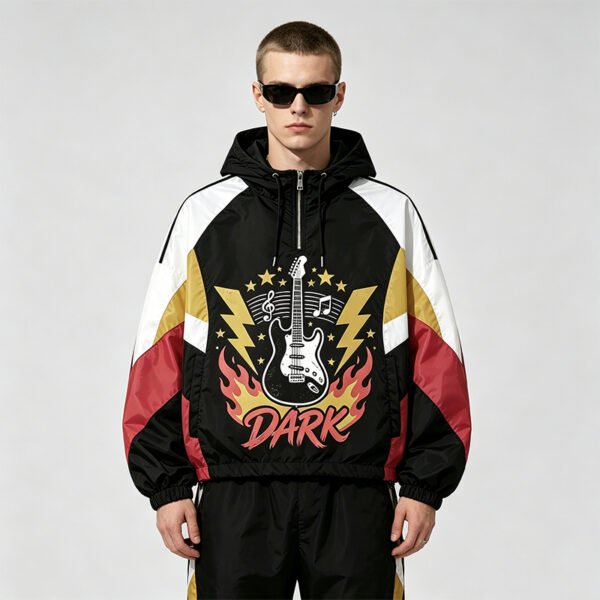
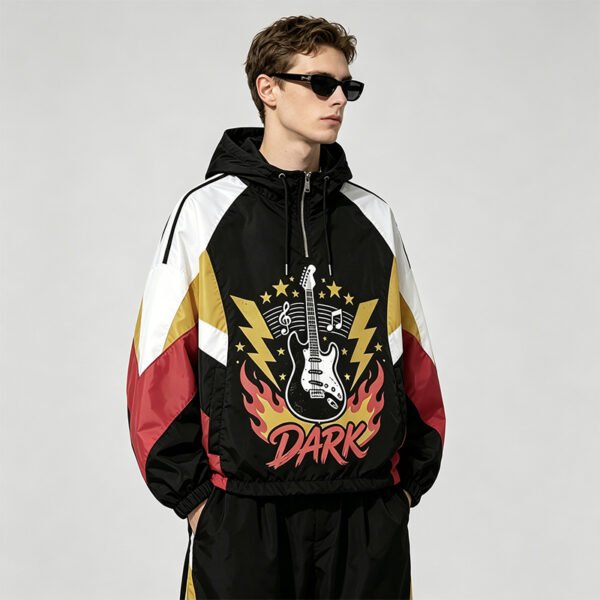
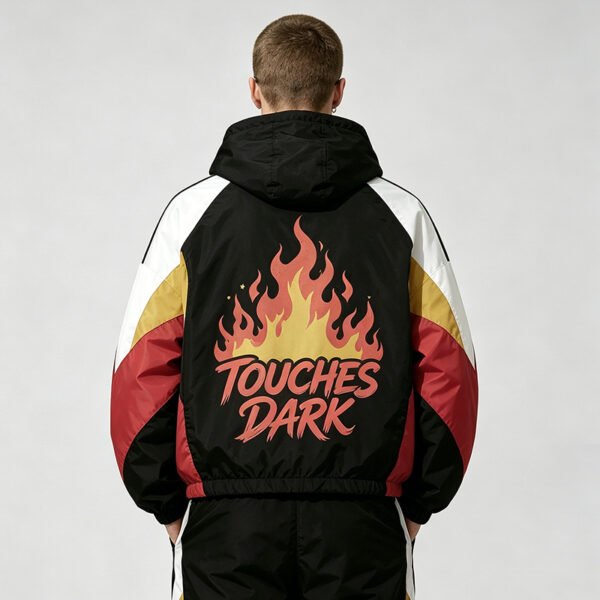



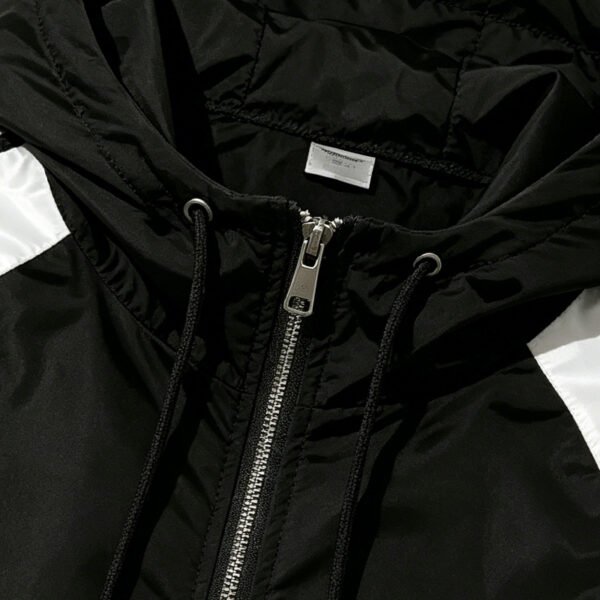







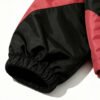
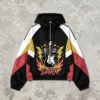
This jacket presents a focused development opportunity: engineer lower-front pockets around a large graphic and high-contrast panel layout. The visible design demands accessible storage without allowing carried weight to distort artwork, pull the hem, or stress color-block junctions during wear and production.
Pocket Mapping Around the Graphic
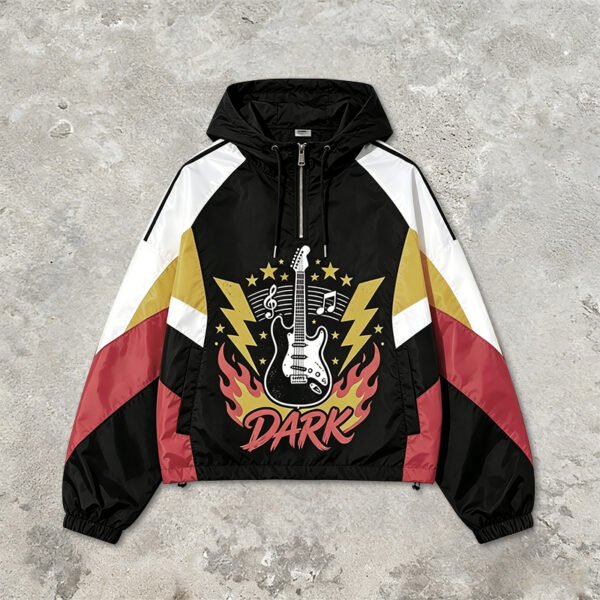
The primary design tension is spatial: the front graphic occupies the visual center, while lower pockets need practical hand entry. Positioning openings below the artwork keeps the motif readable and gives the wearer a natural access path without cutting through its strongest focal elements.
Pocket height should be checked against the intended size range, torso length, and relaxed stance shown in the image. A pocket placed too low can increase hem drag when loaded; one placed too high can crowd the graphic and reduce comfortable elbow clearance during movement.
Load Transfer at Panel Junctions
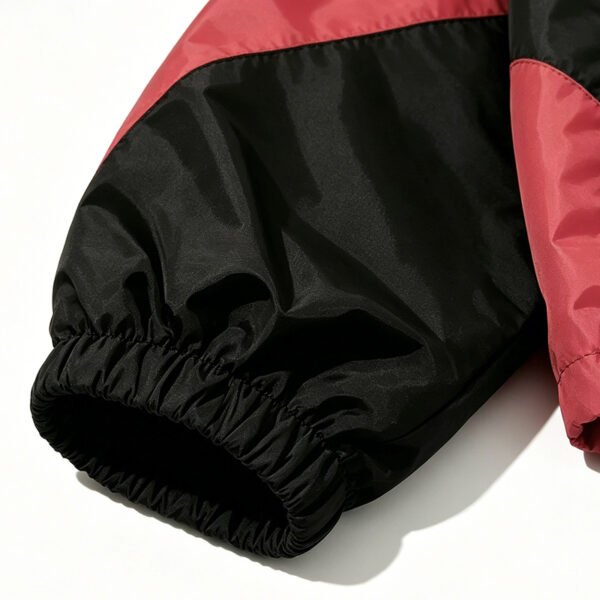
The color-block construction introduces several seam intersections near the lower front and side body. These junctions can become stress concentrators when pockets carry phones, tools, or accessories, so reinforcement should follow the pocket opening, corner turns, and nearby seam direction rather than rely on appearance alone.
VeeWen's development workflow should translate the approved pocket map into a pattern with marked reinforcement points, stitch specifications, and graphic exclusion boundaries. Sample review can then examine pocket sag, seam rippling, and panel alignment together, instead of approving storage and artwork as separate decisions.
Access, Retention, and Daily Use
The supplied image supports a clean lower-front storage concept, but it does not verify closures or internal pocket construction. Buyers should decide whether the product needs open hand pockets, zip security, snap retention, or a concealed solution based on the planned customer use and price architecture.
Each closure changes the load path and visual balance. A zip adds security but increases bulk near the opening; an open pocket improves speed but may release contents. These trade-offs should be resolved before grading, because pocket bag dimensions and reinforcement depend on the chosen function.
Protecting Artwork During Construction
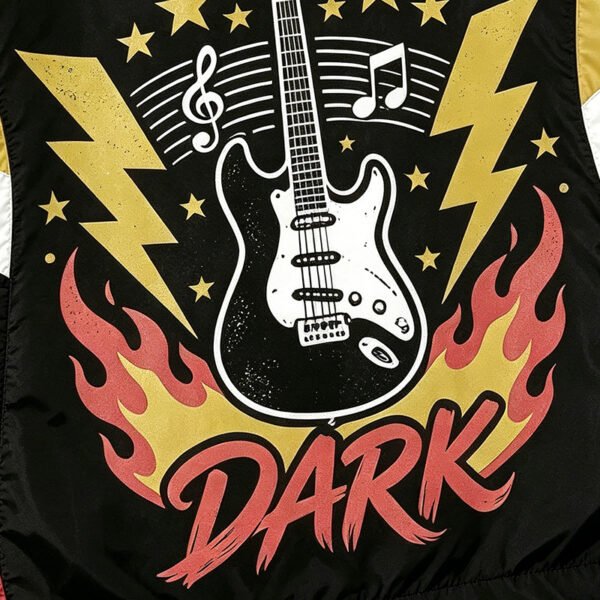
The central print is visually dominant, with lettering, musical symbols, flames, and a guitar arranged across the black body. Pocket placement must therefore preserve a clean print field, avoiding openings, bar tacks, or seam allowances that could interrupt recognizable elements or create registration-sensitive distortions.
For VeeWen, the practical checkpoint is a combined artwork-and-pattern review. The team can overlay pocket templates on the approved graphic artwork, then confirm pressing, sewing, and handling order so the front remains visually centered after construction and finishing.
Wear Testing the Lower Front
A pocket can appear balanced on a flat sample yet behave differently when the wearer sits, walks, or carries weight. Evaluation should observe hand entry, pocket mouth opening, hem recovery, and the relationship between loaded storage and the color-block panel lines visible on the reference garment.
The approval sample should include representative pocket contents and the intended size range. Record whether contents migrate, whether the lower body twists, and whether the graphic remains visually stable. These observations give the buyer a concrete basis for adjusting position, bag depth, or reinforcement before bulk cutting.
Approval Gate for Production Release
The commercial release decision is not simply whether the jacket looks accurate. Buyers should approve a pocket engineering sheet that identifies opening placement, closure type, bag material, reinforcement method, seam tolerances, and the protected area around the front graphic.
Once those points are confirmed, VeeWen can carry the decision through pattern development, graded sampling, decoration placement, and pre-production review. The final checkpoint is a signed sample showing usable storage, controlled load transfer, and uninterrupted graphic impact at the approved colorway.
Buyer Questions
What pocket construction should buyers specify first?
Specify opening location, closure preference, pocket-bag depth, intended carried items, and reinforcement points before approving patterns or grading for production.
Can the graphic extend below the pocket area?
It can, subject to the final pocket template, artwork boundaries, seam allowances, pressing access, and confirmation that construction will not interrupt key graphic elements.
Is the shell water-resistant?
Water resistance is not verified by the supplied evidence. Confirm shell composition, finishing treatment, testing requirements, and care instructions during technical development.
What is the minimum commercial quantity?
MOQ: 100 pieces per style. Final colorway, size ratio, decoration details, and approved specifications should be confirmed before production planning.
Approve the Pocket Engineering Brief
Send the intended carry profile, pocket closure preference, artwork file, and target size range. VeeWen can then develop a sample focused on access, reinforcement, graphic protection, and lower-body stability.


Reviews
There are no reviews yet.