







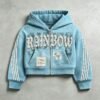






This custom cropped zip hoodie is developed around directional stretch and placement discipline. The supplied image shows a short boxy body carrying applique, rhinestones, sleeve stripes, pockets, and a center zipper, so every decorative landmark must be positioned against the fabric's behavior rather than appearance alone.
Stretch Direction Controls the Cropped Silhouette
A cropped boxy hoodie has limited vertical length, so small distortions can change the perceived proportion quickly. Stretch direction influences zipper straightness, hem level, pocket opening, and how the short body settles when the wearer moves.
VeeWen should map the fabric's usable stretch and recovery before finalizing the pattern. The buyer can then approve whether the body, rib hem, and sleeve panels share a consistent direction or require deliberate orientation changes for appearance and stability.
Placement Must Follow Structural Landmarks
The image shows a centered zipper, chest lettering, two pockets, sleeve stripes, and a hood carrying small embellishments. These elements create a dense placement map where even modest shifting can make the garment look uneven when zipped or worn open.
Artwork and trims should be registered to the center front, pocket edges, sleeve seams, and hood fold lines. Buyers should review placement on the actual pattern pieces, not only a flat artwork file, because seam allowances change the visible relationships.
Applique Adds Local Weight and Rigidity
Raised applique lettering creates a firmer area across the chest than the surrounding knit. When the body stretches, that contrast can pull the panel, interrupt print alignment, or make the zipper appear offset if the applique is positioned without considering fabric movement.
The development sample should test applique edge security, backing behavior, and panel balance during opening and closure. Approval should confirm that the lettering remains legible without creating ripples around the zipper tape or pocket entrances.
Rhinestones Need a Movement-Aware Layout
Small rhinestones are visible across the hood, shoulders, sleeves, and body in the supplied image. Their decorative value depends on spacing, but their placement also interacts with stretch, seam handling, folding, and the wearer's repeated arm movement.
VeeWen should establish a placement grid that avoids critical seam lines and records acceptable spacing variation. Buyers should inspect the garment zipped, open, flat, and worn, checking that sparkle distribution remains intentional without pulling the surrounding fabric.
VeeWen Workflow Protects Pattern-to-Trim Alignment
For this style, VeeWen's workflow should begin with a stretch-direction map, followed by pattern landmarks for zipper, pockets, stripes, applique, and rhinestones. This sequence turns the visual concept into coordinated instructions for pattern, printing, embellishment, and sewing.
The development file should preserve the approved pattern orientation and trim coordinates alongside sample comments. That record helps each operation work from the same reference, reducing the chance that a correct individual component becomes misaligned after assembly.
Buyer Approval Requires Closed and Open Views
The final checkpoint is not limited to a flat front image. A cropped zip hoodie can look aligned when open yet reveal center-front, pocket, or applique displacement when closed, especially if stretch pulls across the decorated chest.
Approve the sample after reviewing both closure states, sleeve movement, hood placement, and embellishment spacing. Confirm material data and care direction separately, then release the style only when directional behavior supports the intended compact silhouette.
Buyer Questions
Why does stretch direction matter for this hoodie?
It affects zipper alignment, hem level, pocket balance, sleeve appearance, and how the cropped body changes shape during movement and closure.
Are the rhinestone specifications confirmed?
No. Rhinestone type, attachment method, spacing tolerance, and durability remain To Confirm through buyer-approved trim and sample documentation.
How should applique placement be checked?
Review the applique against the center zipper, pockets, and actual pattern pieces in open and closed views before approving the production layout.
What is the minimum order quantity?
The exact commercial minimum is MOQ: 100 pieces per style, subject to final specifications, artwork approval, and production planning.
Approve the Placement Map
Share the material reference, artwork, trim preferences, size range, and closure requirements. VeeWen can coordinate stretch mapping, pattern landmarks, applique, rhinestones, sleeve stripes, and sample approval for this cropped hoodie.


Reviews
There are no reviews yet.