









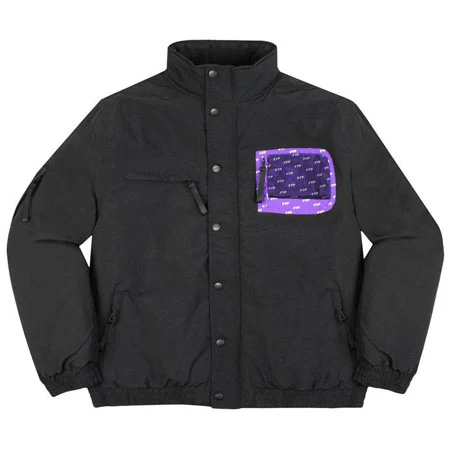
This custom dark utility jacket is built around placement discipline across sizes. Its layered pockets, central snap placket, and red contrast stitching divide the front into fixed landmarks, so decoration must be graded around construction rather than placed by eye.
Why Placement Must Follow Landmarks
The front is visually segmented by the snap placket, chest pockets, lower pockets, yoke lines, and red stitching. A graphic placed from a single center measurement can collide with a flap, disappear under a pocket, or lose its intended relationship to the collar.
The development map should anchor artwork to stable construction points such as the placket edge, pocket opening, yoke seam, and hem. These references remain more reliable than a fixed distance from the garment edge when widths and lengths change by size.
Pocket Architecture Changes the Available Area
Large patch pockets add practical function but reduce uninterrupted print space. Their flaps and raised edges also create visual and physical boundaries, meaning an artwork that looks balanced on a blank front may feel crowded once pocket depth and hardware are included.
Each decoration zone should be assigned before final artwork approval. The buyer can then decide whether branding belongs above the chest pocket, beside the placket, on a pocket flap, or on the back where fewer construction interruptions may occur.
Grading the Graphic, Not Only the Jacket
As sizes increase, body width and sleeve length do not always expand at the same rate. If one artwork file is simply enlarged or shifted proportionally, its relationship to the chest pocket, cuff, and lower hem can become inconsistent across the assortment.
VeeWen's pattern and artwork review should define size-band rules for scale, position, and clearances. Some marks may stay optically stable, while larger graphics can receive controlled adjustments that preserve hierarchy without overwhelming smaller sizes.
Contrast Stitching as a Placement Guide
The red stitching provides a visible map of the garment's construction. Collar edges, pocket borders, placket lines, cuffs, and hem create a deliberate framework that can either support decoration or compete with it if artwork crosses too many red lines.
A placement proof should show artwork and stitch paths together, not on separate pages. This lets the buyer judge whether the graphic reinforces the utility geometry, sits comfortably within a panel, or needs to move into a quieter area.
VeeWen Product-Development Checkpoint
VeeWen can organize this jacket around a placement matrix linking graded measurements, pocket dimensions, seam landmarks, and artwork boundaries. That workflow makes each size an intentional composition and gives production teams a clear reference for positioning during cutting and decoration.
The buyer checkpoint is a size-range review using at least the smallest, middle, and largest planned sizes. Approve when print clearances, pocket access, stitch visibility, and overall hierarchy remain consistent across those representative samples.
Trade-Offs Before Bulk Approval
Keeping artwork away from pockets improves clarity and reduces construction conflicts, but it may leave the front less distinctive. Printing across a pocket can create stronger utility character, yet introduces alignment, edge, and access decisions that require more exact execution.
Select the placement strategy according to the product's commercial role: restrained branding, visible chest impact, or an integrated workwear graphic. Confirm pocket construction and decoration sequence together before approving the final graded production file.
Buyer Questions
What is the most important approval for this jacket?
Approve the landmark-based placement map across representative sizes before confirming artwork scale, pocket dimensions, or decoration instructions.
Can graphics be placed over the utility pockets?
They can be considered, but pocket flaps, openings, seam allowances, hardware, and access requirements must be reviewed before approving that zone.
Why are three sizes useful during placement review?
The smallest, middle, and largest sizes reveal whether artwork clearances and visual hierarchy remain intentional as body and sleeve dimensions change.
What is the minimum order quantity?
The commercial minimum is MOQ: 100 pieces per style, with final specifications, approvals, and production documentation required before ordering.
Approve the Placement Map
Share your artwork, size range, pocket priorities, and target measurements for a landmark-based placement review, then approve representative graded samples before production booking.



Reviews
There are no reviews yet.