
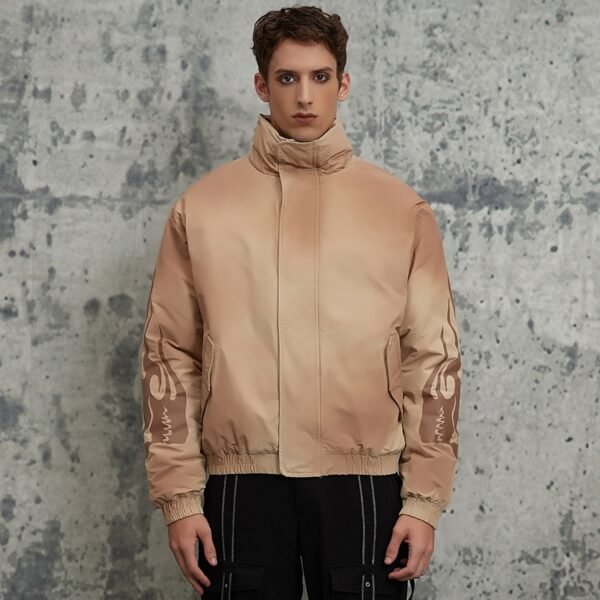


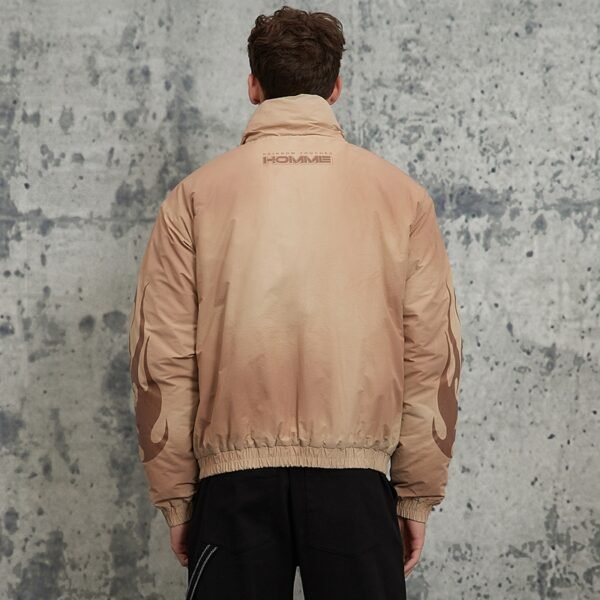

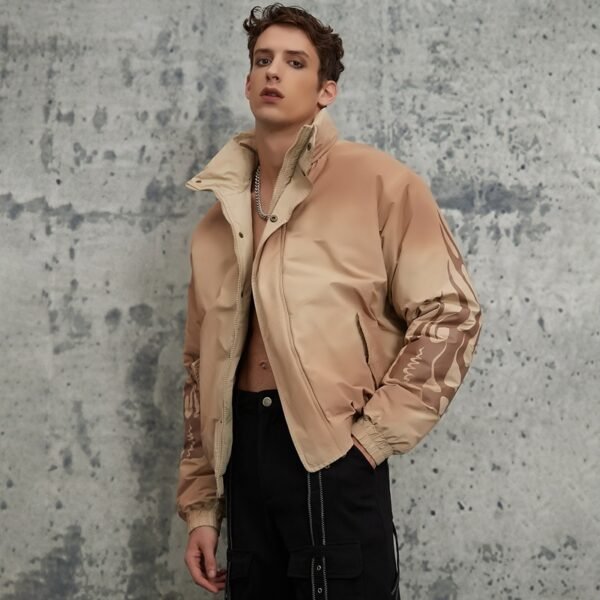

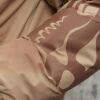



This custom men's puffer jacket turns a restrained tan shell into a controlled statement through mirrored sleeve artwork. The development priority is patch placement and stitch containment, keeping decoration clear of pocket openings, cuffs, insulation channels, and zipper operation while preserving the supplied silhouette.
Patch Boundaries Protect the Jacket Architecture
The image places pale flame artwork on both lower sleeves, leaving the central body uninterrupted. That distribution gives the patch a defined visual address, but it also places stitching near cuffs, pocket bags, and elbow movement, where seam allowances need deliberate mapping.
For sampling, VeeWen should establish artwork bounding boxes before finalizing patch dimensions. The approval should show the patch edge relative to cuff ribbing, side seams, sleeve width, and pocket openings, because each clearance controls puckering, access, and repeatability.
Stitch Containment Controls Surface Distortion
Insulated outerwear can distort when dense embroidery or patch stitching gathers the shell and compresses filling. Containing the attachment within a planned stabilizer zone helps distribute needle penetration, while avoiding unnecessary stitch density across curved or highly mobile sleeve sections.
The trade-off is visible definition versus flexibility. A larger, denser attachment may sharpen the flame motif but stiffen the arm; a lighter contained treatment can preserve movement while producing softer edges. The buyer should approve the intended balance through a physical sleeve sample.
Artwork Placement Supports Size Grading
Mirrored lower-sleeve placement creates a repeatable visual rule across sizes, but the artwork cannot simply scale without checking sleeve circumference and cuff position. Grading must preserve the motif's relationship to the wrist, elbow, and side seam as proportions change.
VeeWen's development workflow should grade the patch placement alongside the sleeve pattern, then review a base size and a larger size. The checkpoint is not only whether the graphic remains centered, but whether attachment stays clear of construction seams throughout the approved size range.
Functional Openings Need Protected Clearance
The supplied jacket shows angled hand pockets on the lower front and a full central zipper. Although the sleeve artwork is separate from those openings, its lower position means cuff and side-seam tolerances still affect reach, dressing comfort, and how the jacket settles when worn.
During technical review, VeeWen can mark zipper, pocket, cuff, and hem interfaces against the artwork plan. The buyer should confirm that decorative boundaries do not visually collide with access points or introduce stitch lines that could catch, rub, or complicate finishing operations.
Surface Effects Require Repeatable Approval
The tan body has a softly faded, tonal appearance rather than a uniform bright finish, while the sleeve artwork is lighter and more graphic. That contrast makes process consistency important: surface variation must support the patch without changing its apparent scale or edge definition.
VeeWen's workflow should separate color approval from placement approval, using the supplied image as visual direction rather than a verified recipe. The buyer should sign off on acceptable spray variation, artwork contrast, and patch edge character before the production specification is released.
Production Release Follows Containment Approval
This style is commercially strongest when its decorative treatment remains intentional and controlled. The buyer's final decision should cover artwork files, patch substrate, stitch method, stabilizer approach, seam clearances, color tolerances, and graded placement, with unresolved composition and performance items listed as To Confirm.
VeeWen can then carry the approved decisions into pattern engineering, sample review, and the production file for MOQ: 100 pieces per style. The key release question is whether the sleeve statement survives handling and grading without compromising insulation, mobility, or factory repeatability.
Buyer Questions
Can the sleeve artwork be changed for a private-label collection?
Yes. VeeWen can develop revised artwork files and placement maps, subject to confirming the attachment method, stabilizer requirements, clearances, and approved sample appearance.
Should the patch extend across the cuff area?
The supplied image suggests artwork near the lower sleeve, but cuff overlap should remain a buyer decision after reviewing movement, seam clearance, and finishing implications.
What must be approved before sampling begins?
Approve the artwork boundary, patch scale, sleeve location, color direction, stitch containment plan, and base pattern measurements before the first development sample is reviewed.
What is the minimum order for this style?
The commercial minimum is MOQ: 100 pieces per style. Final material, decoration, packaging, and grading details should be confirmed within the production specification.
Approve the Sleeve Containment Plan
Send the artwork direction, target size range, and preferred patch treatment to VeeWen. We will align sleeve boundaries, stitch containment, material confirmations, and the MOQ: 100 pieces per style checkpoint.


Reviews
There are no reviews yet.