

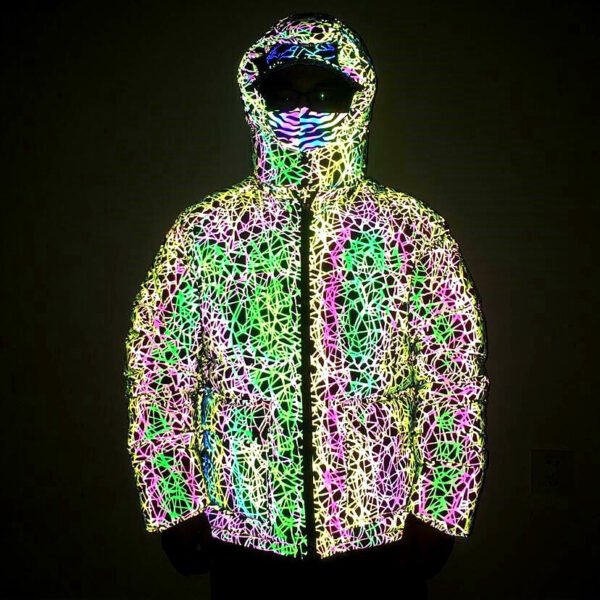

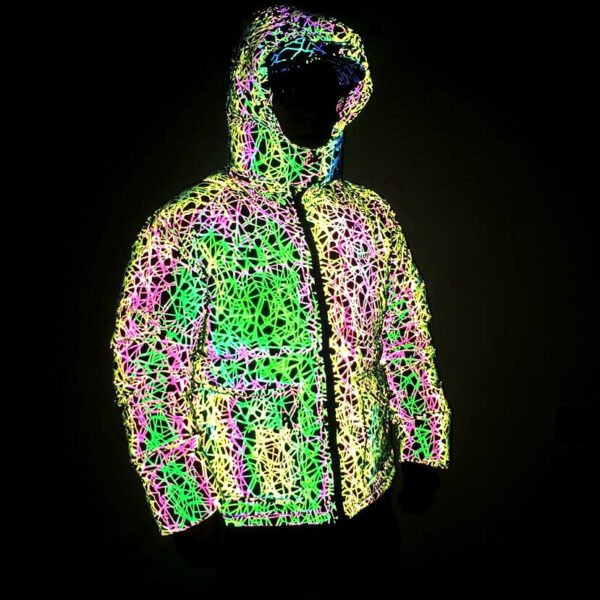

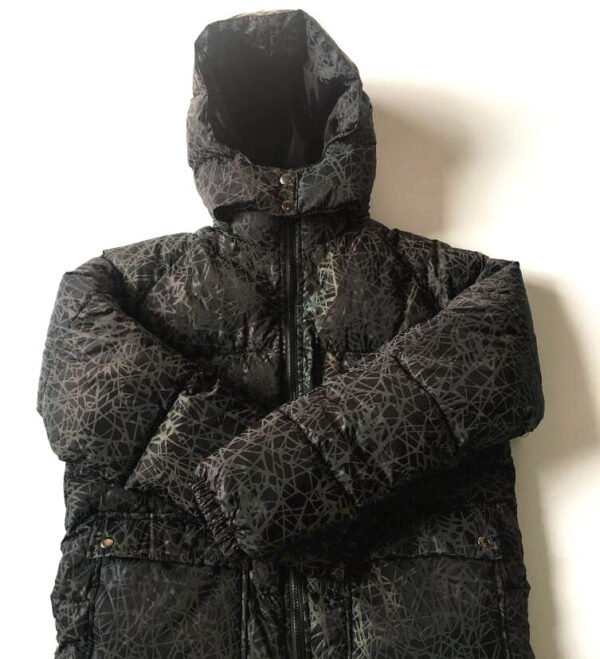

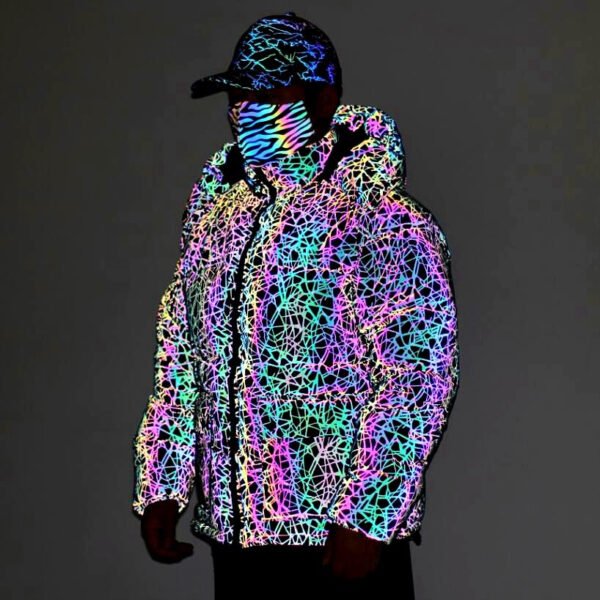
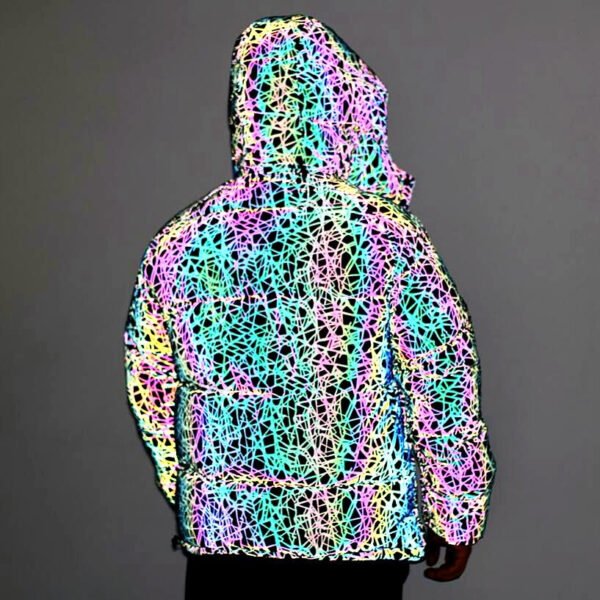




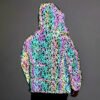
This puffer jacket is developed around controlled elastic insertion, because closure tension can determine whether a bulky silhouette seals cleanly or rotates around the wearer. The supplied imagery shows hooded coverage, rib-free elastic cuffs, a toggle hem, and reflective shell variation requiring coordinated pattern engineering.
Elastic Placement Controls the Puffer Silhouette
In a padded jacket, elastic is not decorative binding; it pulls fabric toward a fixed circumference. If insertion is uneven, one sleeve can ride upward while the hem angles around the torso. The sample should therefore map tension at each closure point.
The image shows cuffs gathered closely at the wrists and a lower drawcord emerging near the side hem. Those details create separate adjustment zones, allowing the pattern team to tune weather coverage and silhouette control without compressing the entire jacket.
Preventing Torque Through Panel and Closure Alignment
Quilted volume amplifies small cutting errors because each filled channel resists movement differently. A zipper mounted off-grain, or elastic inserted with inconsistent extension, can rotate the front panels when the wearer reaches forward. Balanced notches and controlled sewing sequence reduce that risk.
VeeWen should review the center-front zipper, hood attachment, cuff openings, and hem casing as one load path. A moving fit test can check whether the reflective panels remain visually centered while the wearer bends, raises arms, and closes the hem.
Reflective Surface Requires Stable Tension
The shell in the supplied image changes from black to green, blue, and violet highlights across the jacket. Reflective or coated surfaces can expose distortion quickly, so excessive elastic pull may create rippling, uneven shine, or misaligned visual blocks around cuffs and lower edges.
The development choice is a measured balance: enough recovery to hold the jacket close, but not so much that the surface buckles. A flat inspection under consistent lighting should accompany the movement test, especially at elastic insertion seams and casing exits.
Hood and Hem Must Work as a Pair
A hooded puffer protects the upper body through volume, while the hem determines whether warm air escapes below. Tightening the hem without accounting for the hood and shoulder balance can make the jacket climb upward, increasing pressure at the neck and changing the intended proportion.
The visible hood is broad and structured, and the lower hem includes adjustable toggles rather than a plain straight edge. During fitting, VeeWen can compare open and tightened settings, confirming that the garment remains level and the hood stays positioned when the wearer turns.
VeeWen Workflow for Elastic and Torque Approval
VeeWen's product-development workflow should translate this axis into a closure specification before bulk cutting: record elastic width, insertion length, extension percentage, casing path, toggle position, and acceptable recovery. These controls make the sample review specific to the garment's mechanical behavior.
The approval checkpoint is a fitted prototype reviewed in static and active positions. The buyer should sign off only when cuffs stay comfortable, the hem returns evenly after adjustment, the zipper line remains straight, and reflective panel placement survives ordinary movement.
Trade-Offs for Commercial Range Planning
More elastic recovery can improve sealing but may narrow the comfortable wearing range, especially over layered clothing. A softer, longer insertion can preserve ease while offering less containment. The correct choice depends on target climate, layering intent, body-size grading, and the desired oversized appearance.
For the requested commercial minimum, MOQ: 100 pieces per style, the buyer should lock the closure recipe alongside the size range and colorway plan. This prevents later substitutions from changing torque behavior after the visual design has already been approved.
Buyer Questions
Is this jacket filled with down?
The supplied evidence does not verify down, synthetic fill, fill weight, or warmth rating. VeeWen should confirm insulation composition and construction through the buyer's approved technical specification.
Can the hem adjustment be customized?
Yes, the visible drawcord and toggle architecture can guide development. Cord route, toggle type, casing dimensions, and recovery targets should be confirmed during prototype approval.
How is torque evaluated during sampling?
Evaluate the jacket while reaching, bending, and rotating, then inspect zipper straightness, cuff position, hem level, and reflective panel alignment after repeated adjustments.
What is the minimum order quantity?
The commercial minimum is MOQ: 100 pieces per style. Final size ratios, color quantities, materials, and approved construction details should be documented before production planning.
Approve the Elastic Architecture
Send your size range, shell reference, insulation brief, and preferred closure tension. VeeWen can develop the sample around measurable cuff recovery, hem adjustment, and torque-control checkpoints for buyer approval.


Reviews
There are no reviews yet.