
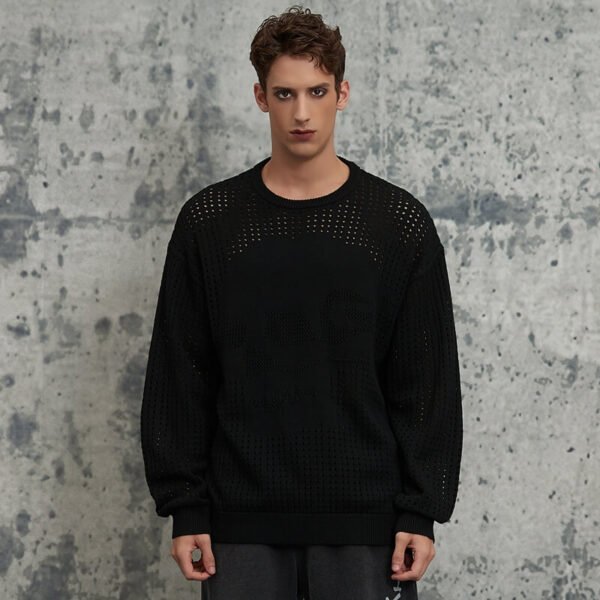


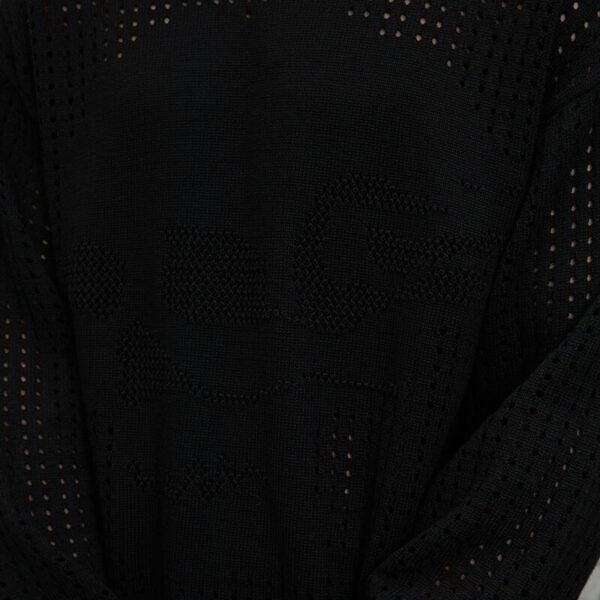








This custom crewneck sweater is developed around tonal knit relief rather than loud color contrast. Its openwork body, denser rib borders, and barely separated skull motif make thread choice inseparable from seam appearance, giving buyers a focused approval route for surface character, stability, and repeatable visual balance.
Why Thread Choice Controls the Motif
In a tonal black sweater, the skull motif cannot rely on printed color separation. Yarn diameter, twist, luster, and elasticity determine how neighboring stitches catch light, so the buyer should judge motif readability under direct, angled, and low-light viewing conditions.
The supplied image shows a central skull emerging subtly from the body rather than sitting above it. That appearance points toward stitch-based relief or tonal patterning, where an unsuitable yarn can flatten the design or make openings look accidental.
Openwork Changes Seam Perception
Visible openings span the shoulders, sleeves, and lower body in the main image, creating a perforated rhythm around the central motif. Because open stitches expose more background, seam lines can become visual interruptions if their density or alignment shifts.
A controlled seam appearance therefore requires the development sample to map stitch transitions at armholes, side seams, sleeve joins, and rib attachments. The objective is not invisible construction, but deliberate continuity between engineered openings and clean garment boundaries.
Balancing Drape With Edge Stability
The body appears relaxed while the neckline, cuffs, and hem look denser and more stable. This contrast helps the sweater hold its outline, but excessive yarn weight or tight rib recovery may make the borders feel disconnected from the openwork body.
VeeWen's workflow should test the selected thread and stitch structure across the complete panel sequence, then review shrinkage, edge recovery, and hanging balance before approving production grading. The buyer's checkpoint is a consistent silhouette after handling, not only a strong first photograph.
Motif Placement Requires Technical Mapping
A central skull motif must remain legible across graded sizes, even as chest width, sleeve length, and armhole proportions change. Scaling only the artwork can distort eye placement, jaw width, and surrounding negative space when the knit panels expand.
During product development, VeeWen can translate the approved artwork into stitch maps for each required size and identify high-risk transitions before knitting. Buyers should approve the motif grid, panel alignment, and tolerance for minor stitch variation as one technical package.
Seam Appearance Is a Buying Decision
For this design, seam appearance affects whether the sweater reads as intentional streetwear knitwear or as an uneven open mesh garment. Shoulder joins, sleeve seams, and rib attachments should support the motif's quiet contrast instead of competing with it.
The review should compare the front, back, and three-quarter views under the same lighting, using the supplied image as a visual direction rather than a performance guarantee. Approve only when construction lines remain orderly without erasing the surface texture.
VeeWen Development Checkpoint
VeeWen should begin with a thread and stitch consultation tied specifically to the motif's tonal visibility, then build a development sample that exposes the relationship between openwork density and seam placement. This keeps the manufacturing discussion centered on the sweater's actual visual mechanism.
Before confirming MOQ: 100 pieces per style, the buyer should sign off on yarn reference, stitch map, graded motif placement, rib proportions, and seam-appearance tolerance. That approval creates a measurable handoff from concept direction to production-ready knit specifications.
Buyer Questions
Is the sweater composition confirmed?
No. The supplied evidence identifies knitwear and visual construction, but it does not verify fiber content, yarn count, gauge, or performance characteristics.
What should buyers review first?
Review yarn appearance, stitch openness, motif readability, rib density, and seam alignment together, because changing one variable can alter the entire surface balance.
Can the motif be adapted for different sizes?
Yes, adaptation should be handled through size-specific stitch mapping, with buyer approval for scale, alignment, negative space, and acceptable variation before production.
What is the commercial minimum?
VeeWen's exact commercial minimum is MOQ: 100 pieces per style, subject to confirming the approved technical package and production requirements.
Approve the Knit Structure Before Production
Send your motif artwork, target color, size range, and preferred hand-feel to VeeWen for a focused development review covering yarn, stitch mapping, rib balance, and MOQ: 100 pieces per style.


Reviews
There are no reviews yet.