


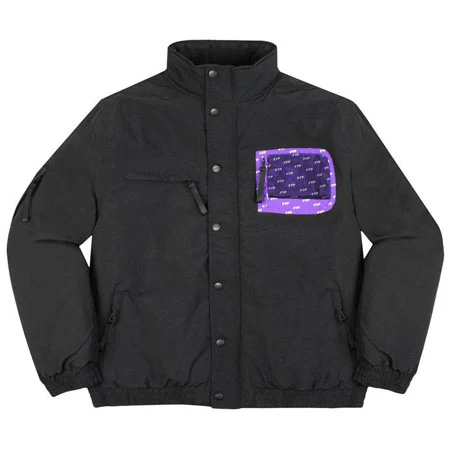
This varsity jacket should be developed around closure usability within a visually dense front. The supplied image shows a broad body, rib framing, prominent chest lettering, and sleeve graphics, while its snap-front appearance makes zipper puller scale a deliberate future hardware checkpoint.
Why Puller Scale Matters
A jacket closure is handled repeatedly, often while the wearer is moving or wearing gloves. An undersized puller can be difficult to grasp through a substantial front, while an oversized puller may strike graphics, distort the tape, or dominate the garment's visual hierarchy.
The image presents enough body volume and graphic density to make this balance commercially relevant. The buyer should treat the puller as a functional component with a visual footprint, not a minor accessory selected after the jacket's artwork and trim have been finalized.
Reading the Front Geometry
The broad light-blue body, ribbed collar, and snap positions establish a strong vertical centerline. If a zipper replaces or supplements the visible snaps, its tape, teeth, slider, and puller must remain centered while allowing the front panels to close without disturbing the chest artwork.
Prominent lettering crosses the upper front, so clearance should be checked where the puller travels and rests. A puller that overlaps applique edges may snag or create thickness; a puller positioned too far away may compromise closure alignment and hand access.
Operational Clearance and Hand Access
Operational clearance means the user can grasp, start, and move the puller without catching adjacent rib, applique, or pocket construction. Review should include the closed position, open position, and transition through the collar area, where layered materials often increase resistance.
There is a clear trade-off between a compact puller and a more generous grip. Compact hardware can look refined and reduce interference, while larger hardware improves handling but adds weight and attention. The preferred dimension should follow wearer use, garment thickness, and approved styling intent.
Graphic and Hardware Coordination
The chest lettering, sun-like emblem, and sleeve graphics make the jacket read through layered visual information. Hardware should therefore support the composition by occupying its own controlled zone, with puller length, finish, and resting position coordinated against the artwork boundaries.
The visible snap-front reference also creates a useful comparison during development. A zipper may improve continuous closure, but it changes front weight, seam behavior, and visual rhythm. The buyer should approve the closure architecture before artwork placement is frozen.
VeeWen Development Workflow
VeeWen can develop this jacket by establishing the front closure line, mapping rib and artwork exclusion zones, then testing puller size on a construction sample. The review should observe actual hand movement, not only a flat technical drawing or digital placement.
Once the hardware sample is accepted, the closure dimensions can be carried into the pattern, trim sheet, and artwork coordinates. This product-specific sequence helps prevent late conflicts between the puller, chest graphics, collar layers, pocket openings, and front-panel alignment.
Buyer Approval Gate
The approval sample should demonstrate easy grasping, smooth travel, stable closed alignment, and sufficient clearance from graphics and rib edges. Inspect both sides of the front, because uneven tape tension can shift the puller away from the intended centerline.
Approve the jacket when operation feels natural and the hardware remains visually subordinate to the varsity identity. If clearance is weak, revise puller geometry or surrounding construction before confirming the final trim package and bulk cutting instructions.
Buyer Questions
Does the image confirm a zipper closure?
No. The supplied image visibly presents a snap-front appearance. A zipper option requires separate hardware development, operating review, and approval against the existing front construction.
Why review puller clearance before artwork lock?
The puller can overlap, snag, or visually compete with chest graphics. Establishing its operating zone early protects both usability and the approved graphic composition.
Can the puller be customized?
Potentially, yes. Shape, scale, finish, and branded detailing can be developed, subject to hardware feasibility, clearance requirements, and buyer approval of the physical sample.
What is the minimum order?
MOQ: 100 pieces per style. Confirm final quantities, size ratios, colorways, hardware choices, and artwork specifications within the approved production package.
Approve Closure Clearance
Share the intended closure, artwork files, and wearer-use requirements. VeeWen can then test puller scale, hand clearance, and front-panel coordination before the varsity jacket enters final production approval.



Reviews
There are no reviews yet.