






This custom micro-flare pant turns a narrow streetwear silhouette into a hardware-clearance exercise: the waist must operate cleanly while long puller ends, graphic panels, and a widening hem remain visually balanced. VeeWen can develop the pattern around these competing requirements for a controlled sample review.
Why Puller Scale Controls the Front View
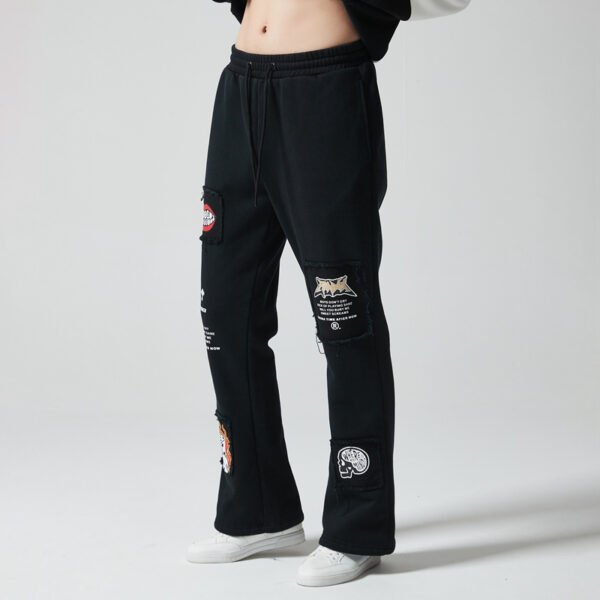
The supplied image places two long drawcord ends directly below a gathered waistband, so puller scale affects both hand access and visual weight. Oversized ends can interrupt the clean front line, while undersized hardware may disappear or become difficult to operate.
For a knitted blended fabric, the waist opening can relax differently from a rigid woven. VeeWen should therefore grade puller length and exit reinforcement together, checking that the cord remains accessible without allowing excessive stretch, twisting, or face distortion.
Operational Clearance at the Waist
Operational clearance means the puller, cord channel, and wearer's fingers need room to move independently. The visible center placement provides a starting reference, but the final map must account for seam allowances, elastic recovery, waistband depth, and the selected cord construction.
A tight clearance may create snagging or pull stress; excessive clearance can make the drawcord look uncontrolled. The development target is a repeatable adjustment path that stays centered during movement and does not compete with the graphic work below.
Balancing a Narrow Leg with Graphics
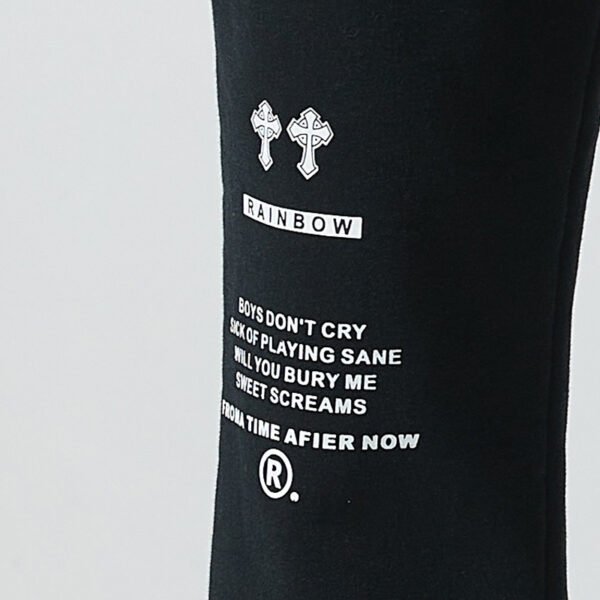
The image shows a close leg line carrying several high-contrast motifs, including a red lip-like patch, a lower orange graphic, and smaller monochrome details. This density makes placement tolerance important because even small shifts can change the perceived balance of the trouser.
The micro-flare should remain subtle enough that the graphics do not appear to lean or drift toward the hem. Pattern development should align motif centers with the leg grain, then verify placement across sizes before locking decoration templates.
Knit Behavior and Decoration Load
The source wording identifies knitted blended fabric, but supplies no percentages, weight, recovery data, or decoration specification. Those unknowns matter because stretch, surface stability, and local thickness influence how patches, prints, and reinforcement behave during wear.
VeeWen should isolate each decoration method during sampling and inspect the surrounding knit for rippling, show-through, or restricted movement. The buyer can then choose a balanced decoration package instead of approving visual density without understanding its construction consequences.
VeeWen Development Workflow
VeeWen's workflow for this style should begin with a measurement map connecting waistband depth, cord exits, puller dimensions, and front graphic positions. The first approval checkpoint is a fit sample that confirms operation before decoration is treated as final.
After the waist is validated, the pattern, grading, graphic placement, and finishing notes can be consolidated into a production-ready specification. A second checkpoint should review the decorated sample for clearance, hem flare consistency, and surface behavior.
Buyer Approval Checkpoint
Approve the pant when the puller can be grasped quickly, remains clear of the waistband seam, and does not obscure the front graphic composition. Review the garment both flat and worn, because cord behavior and knit recovery can change between positions.
The key trade-off is visual restraint versus adjustment ease. A shorter or smaller puller may look cleaner, while a more generous puller improves handling. Confirm the priority, then record dimensions and tolerances before authorizing the style.
Buyer Questions
Is the fabric composition confirmed?
No. The source mentions knitted blended fabric, but no fiber percentages or performance data are supplied, so composition and recovery remain To Confirm.
What does the puller clearance review include?
Review puller dimensions, cord exits, waistband depth, seam allowances, finger access, snag risk, and centered operation while standing, walking, and sitting.
Can the graphic layout be changed?
Yes. Treat the supplied image as directional evidence, then confirm artwork scale, placement, decoration method, and size grading through the approved development specification.
What is the minimum order?
The commercial minimum is MOQ: 100 pieces per style. Final colors, artwork, measurements, and construction details should be approved before production planning.
Approve the Waist Hardware Map
Send the intended puller dimensions, cord preference, size range, and artwork direction to VeeWen for a focused sample review before committing to production.


Reviews
There are no reviews yet.