


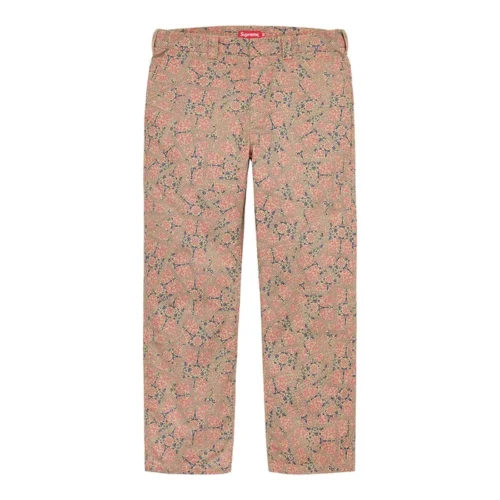
This custom vintage panelled pant is built around a production problem hidden inside its relaxed appearance: contrasting panels must feel intentionally balanced while the garment moves. The supplied image shows mirrored leg architecture, irregular tonal blocks, cropped raw hems, and localized distress that all require separate approval controls.
Panel Mapping Creates the Visual Balance
The supplied image uses multiple tones across each leg, yet the overall pair remains visually grounded around the center front. That balance comes from panel placement, pocket alignment, waistband positioning, and the relationship between left and right component boundaries.
Because the color blocks are prominent, small pattern shifts can change the perceived stance of the trousers. VeeWen should create a numbered panel map showing grain direction, color family, seam position, and mirrored counterpart before approving the cutting layout.
Mirror Components Before Adding Irregularity
The design appears irregular because its panels carry different shades and wash marks, but the underlying leg structure remains comparable from side to side. Mirrored front pieces, pocket entries, drawcord exits, and hem references provide the stable framework for that controlled irregularity.
A buyer should distinguish intentional variation from assembly drift. The development sample should be photographed from front and back, with left and right measurements recorded, so panel placement can be corrected before distress and wash effects obscure the comparison.
Manage the Center Front and Waistband
The drawstring waist establishes a strong vertical center reference between the legs. Its casing, cord exits, and front rise must remain centered even when adjacent panels vary in shade, because misalignment will make the entire garment appear twisted or poorly balanced.
The image shows the waistband gathered around a relaxed fit, with hands entering the side pockets. VeeWen should confirm waistband recovery, cord length, pocket symmetry, and rise comfort while checking that the center-front panel junction remains stable during wear.
Use Wash Variation Without Losing Pairing
The trousers combine charcoal, beige, tan, and brown areas with soft transitions and visible tonal wear. Such variation can enrich the vintage effect, but each leg still needs an approved relationship between dark and light zones to keep the pair commercially coherent.
Wash testing should compare matched garment pairs rather than isolated pieces. VeeWen can assign an approved tolerance for shade movement, speck density, and panel contrast, allowing natural variation while protecting the intended symmetry and recognizable front view.
Approve Raw Hems and Distress as Boundaries
The cropped hems show loose threads and an intentionally unfinished edge, while one knee carries a concentrated distressed opening. These features create visual punctuation, but their position and size must be controlled so they do not overpower the panel arrangement.
The buyer should approve hem length, fray allowance, knee placement, and speck distribution on a worn sample. Movement matters because the cropped leg exposes footwear and changes how the lower panel boundaries read during walking and sitting.
VeeWen Development Checkpoint
VeeWen should begin with a mirrored component chart covering left and right panels, pocket pieces, waistband sections, drawcord exits, and hem references. The chart then guides pattern review, cutting, sewing, wash sampling, and final pair comparison around one measurable axis.
At the release checkpoint, compare paired garments on a flat table and on a fit model. Approve only when center alignment, panel balance, waist comfort, distress placement, and hem character remain within the agreed tolerance for MOQ: 100 pieces per style.
Buyer Questions
Is the 100% cotton composition verified?
It is stated in the supplied source wording, but final labeling should follow the approved fabric specification and any required material verification completed during development.
Why is symmetry important for this design?
Symmetry stabilizes the garment's visual frame while contrasting panels and wash effects introduce variation. Without mirrored references, small assembly differences can make the pants appear unintentionally uneven.
Which sample views should buyers review?
Review front, back, side, flat-lay, and movement views. Check center alignment, panel pairing, pocket position, waistband comfort, distress placement, and hem behavior after the intended wash process.
What is the minimum order?
The commercial minimum is MOQ: 100 pieces per style. Confirm fabric, panel map, wash appearance, distress limits, sizing, and finishing details before production planning.
Approve the Mirrored Panel Map
Share your target measurements, panel artwork, wash references, and distress preferences with VeeWen. We will prepare a mirrored component review and development sample before confirming the final style package and MOQ: 100 pieces per style.


Reviews
There are no reviews yet.